Water Leak Detection & Moisture Mapping in Aurora, CO
Aurora Water Leak Detection for Hidden Moisture, Water Stains and Unexplained Water Damage
Seeing a water stain on the ceiling, wet carpet near a wall, swollen baseboards, damp drywall, a musty odor, or a high water bill but no visible leak? Creek Auro Restoration provides Water Leak Detection Aurora CO homeowners, property managers, and business owners can rely on when water may be traveling behind a wall, beneath flooring, above a ceiling, or through other concealed building materials.
Our team uses careful inspection, moisture readings, water-damage documentation, and structural-drying expertise to identify affected materials, map the direction of moisture migration, and recommend the right next step. That may include emergency water removal, drying, a plumber or roofing specialist for source repair, targeted access to a concealed area, or water-damage reconstruction after materials are stabilized.
Creek Auro Restoration has served Aurora and surrounding Denver metro communities since 2010. With 40 skilled professionals, 10 equipped service vans, and 24/7 emergency availability, we respond when water damage cannot wait.
Call +1 (719) 715-6006 for Water Leak DetectionCall now for emergency leak assessment, moisture mapping, water-damage documentation, and structural drying support in Aurora, CO.
- Water leak detection and moisture mapping for homes, rentals, HOAs, and commercial properties
- Emergency response for wet drywall, ceiling leaks, flooded rooms, burst pipes, and appliance failures
- Moisture readings and affected-area documentation to guide drying and repair decisions
- 24/7 water-damage response across Aurora and the Denver metropolitan area
Request Emergency Water Leak Detection Service
Fill out the form and we'll contact you immediately!
Water Leak Detection Backed by Restoration Experience
Aurora Water Leak Detection for Homes, Businesses and Managed Properties
A hidden water leak is not always easy to locate from the visible damage. Water can travel along framing, behind cabinets, below flooring, through insulation, and across ceilings before it becomes obvious. Creek Auro Restoration approaches every suspected leak as a water-damage investigation—not simply a surface cleanup.
Our team focuses on the condition of the structure, the likely path of water, the materials at risk, and the steps needed to prevent secondary damage. We help Aurora property owners understand what is wet, what may be salvageable, what should be dried, and when a licensed plumber, roofer, appliance technician, or other source-repair specialist should be involved.
Serving Aurora, Arapahoe County, and the Denver metro area since 2010
40 skilled restoration professionals and 10 equipped service vans
24/7 emergency availability for active leaks and water-damage events
Water Damage Restoration Technician, Applied Structural Drying Technician, Applied Microbial Remediation Technician, Master Water Restorer, and Water Loss Specialist credentials
Insurance documentation and direct-billing coordination where appropriate
Residential, commercial, multi-family, HOA, and property-management support
Water Leak Detection Near Aurora Neighborhoods, Landmarks & Business Hubs
Serving Aurora Properties Near Southlands, Anschutz Medical Campus and Aurora Reservoir
Creek Auro Restoration provides water leak detection and moisture mapping for homes and businesses throughout Aurora. Whether a ceiling leak develops in a multi-family property near City Center, a washing-machine line damages flooring in Mission Viejo, an irrigation issue affects a home near Saddle Rock, or a burst pipe threatens a commercial space near the Havana Street Corridor, our team is available to assess the damage and begin the right restoration response.
We serve properties near Aurora Reservoir, Southlands, Town Center at Aurora, Anschutz Medical Campus, Fitzsimons, Buckley Space Force Base, Cherry Creek State Park, Aurora Sports Park, Quincy Reservoir, and major corridors throughout the city.
Aurora Neighborhoods We Serve
Nearby Cities We Serve
Regional Hubs & Property Types
Medical campuses, office buildings, retail centers, restaurants, schools, apartment communities, HOA-managed properties, warehouses, hotels, and mixed-use developments.
Specialized Water Leak Detection and Moisture Mapping for Aurora Properties
Denver Metro Restoration Specialists Focused on Hidden Moisture and Structural Drying
A visible puddle or stain does not reveal the full extent of water damage. Moisture may be trapped beneath tile, inside drywall cavities, behind kitchen cabinets, under carpet padding, within insulation, or below hardwood flooring. That is why a water-damage assessment should focus on the entire affected area—not only the point where water first appears.
Creek Auro Restoration provides restoration-focused water leak detection and moisture mapping for residential and commercial properties. We inspect accessible areas, compare moisture conditions, document readings, identify likely moisture migration, and create a practical plan for extraction, drying, targeted material removal, or reconstruction when needed.
Why Specialized Assessment Matters
- Moisture mapping helps show how far water may have traveled beyond a visible stain or puddle
- Structural-drying knowledge helps determine which materials may be dried and which may require removal
- Documentation supports clearer communication with property owners, plumbers, insurers, and reconstruction teams
- Targeted assessment can reduce unnecessary demolition while still identifying materials that need attention
- Emergency mitigation can begin before water damage becomes a larger drywall, flooring, insulation, or mold-related concern
The ANSI/IICRC S500 standard describes procedures and precautions for professional water-damage restoration in residential, commercial, and institutional properties. It recognizes inspection, investigation, work planning, drying, and documentation as central parts of the restoration process.
What Happens During a Water Leak Detection and Moisture Mapping Visit?
A Clear Process for Finding Moisture Before Targeted Drying or Repair Begins
Water leak detection and moisture mapping are not annual compliance services. They are diagnostic and restoration-planning services used when a property owner sees a water-related symptom, receives a utility alert, experiences a plumbing or appliance issue, or needs to understand the extent of moisture after an incident.
Creek Auro Restoration evaluates accessible areas, documents affected materials, and explains the appropriate next step. If the active source requires plumbing, roofing, appliance, irrigation, or HVAC repair, we can explain why that specialized repair is needed while focusing on the water mitigation and restoration work inside the property.
| Assessment Task | What It Involves | When It Is Useful | Why It Matters |
|---|---|---|---|
| Visual Inspection | Review of visible water, stains, fixtures, materials, and likely source areas | At the start of every suspected loss | Identifies obvious damage and immediate safety concerns |
| Moisture Readings | Comparative readings from affected and unaffected building materials | When drywall, flooring, ceilings, cabinets, or trim may be wet | Helps identify abnormal moisture and the likely spread of water |
| Moisture Mapping | Documentation of elevated-moisture locations and migration patterns | After active water, a hidden leak, overflow, or unexplained stain | Guides drying, monitoring, and targeted access decisions |
| Environmental Readings | Evaluation of humidity and drying conditions where appropriate | During mitigation and structural drying | Helps establish an effective drying plan |
| Documentation Photos | Condition photos, notes, and affected-area records | During assessment and throughout restoration | Supports owners, managers, insurers, and repair planning |
| Drying Recommendations | Extraction, air movement, dehumidification, material removal, or monitoring recommendations | After assessment | Helps prevent secondary water damage |
When to Schedule Water Leak Detection
- After finding a water stain on the ceiling, wall, floor, or cabinet
- When you have a high water bill but no visible leak
- After receiving an Aurora Water continuous-flow alert
- When carpet, drywall, flooring, or baseboards feel damp
- After a burst pipe, frozen pipe thaw, appliance leak, toilet overflow, roof leak, or sump-pump failure
- When a musty smell develops after a leak or water event
- Before beginning broad demolition for a suspected hidden leak
Important note: A moisture meter can identify elevated moisture in materials, but it does not automatically prove the exact source of a plumbing failure. Thermal imaging can identify temperature differences that require closer inspection, but it does not directly see through walls or guarantee an exact leak location. Further source diagnosis may require a licensed plumber, pressure testing, acoustic leak detection, tracer gas testing, roofing inspection, appliance evaluation, or targeted access.
Who Needs Water Leak Detection and Moisture Mapping in Aurora?
Helping Homeowners, Property Managers and Commercial Facilities Across Aurora
Any Aurora property can develop hidden water damage. A small supply-line drip behind a bathroom vanity, an ice-maker line leak under a kitchen floor, a shower leak behind tile, a roof leak after snow or rain, or a failed sump pump can affect more than the visible surface area.
Creek Auro Restoration helps property owners and managers understand the extent of water intrusion and choose a practical mitigation path.
How Aurora Weather, Freeze-Thaw Cycles and Irrigation Affect Water Leaks
Front Range Temperature Changes and Seasonal Water Issues
Aurora's climate can create different water-damage risks throughout the year. Winter cold snaps may freeze vulnerable plumbing, and thawing can reveal pipe damage after temperatures rise. Spring snowmelt, heavy rain, roof vulnerabilities, and exterior drainage issues may cause water intrusion. Summer irrigation use, sprinkler-line leaks, hose-bib problems, and swamp-cooler issues can also create unexplained moisture around a property.
Aurora Water describes the city as having a semi-arid climate, making water conservation and irrigation efficiency locally important. A leak that wastes water can also create property damage if it is not found and corrected.
Winter
Frozen pipes, pipe bursts after thawing, disconnected hoses, poorly insulated lines, and ice-dam roof leaks
Spring
Snowmelt, roof leaks, foundation moisture, gutter overflow, and seasonal irrigation startup
Summer
Sprinkler leaks, wet patches in lawns, damaged irrigation zones, swamp-cooler leaks, appliance condensation, and storm intrusion
Fall
Irrigation shutdown issues, exterior-spigot problems, early cold snaps, roof maintenance needs, and drainage concerns
Aurora Water advises residents to know the location of their master shutoff, disconnect hoses, keep indoor temperatures adequate during freezing weather, and seek plumbing help if a pipe may be frozen.
What Can Cause a Hidden Water Leak in an Aurora Property?
From Plumbing Supply Lines to Roof Leaks, Appliances and Irrigation
Water damage can begin from many sources. The visible damage may be below, beside, or far from the original issue, especially when water follows framing, pipes, floor cavities, or gravity paths through a structure.
| Possible Source | Common Warning Signs | Moisture-Mapping Focus |
|---|---|---|
| Plumbing supply line | Water meter movement, rising bill, wet drywall, low water pressure, running-water sound | Trace suspected moisture around walls, cabinets, floors, and adjacent rooms |
| Drain line or shower leak | Ceiling stain below bathroom, damp wall, musty odor, leak only during use | Evaluate moisture around showers, tubs, toilets, drains, and lower-level ceilings |
| Toilet leak or overflow | Soft flooring, damaged baseboards, water around toilet, ceiling stain below | Identify affected flooring, subfloor, walls, and nearby materials |
| Water heater leak | Utility-room moisture, standing water, corrosion, wet flooring | Document affected flooring, wall materials, equipment area, and adjacent rooms |
| Appliance leak | Wet cabinet, buckled flooring, dishwasher or refrigerator water line issue | Assess under-cabinet, under-floor, and wall-adjacent moisture |
| Roof or ice-dam leak | Brown ceiling stain, drip after snow or rain, peeling paint | Identify interior spread and drying needs after the exterior source is corrected |
| Sump-pump failure | Wet basement, standing water, damp carpet, moisture near floor drain | Support extraction, moisture assessment, structural drying, and documentation |
| Irrigation or exterior leak | Wet lawn patch, water pooling near foundation, high summer bill | Determine whether water has entered or affected the structure |
| Slab or under-floor leak | Warm spot on floor, damp flooring, high bill, unexplained moisture | Help document affected materials and narrow the area before targeted access |
Reliability note: The source of water should be corrected by the appropriately qualified professional. Creek Auro Restoration focuses on identifying moisture impact, emergency mitigation, structural drying, documentation, and restoration planning after water enters the property.
Our 6-Step Water Leak Detection and Moisture Mapping Process
What to expect when Creek Auro Restoration arrives.
Initial Call and Symptom Review
We discuss what you are seeing: a water stain on a ceiling, wet carpet near a wall, a musty odor, a high water bill, meter movement, appliance leak, burst pipe, suspected slab leak, or other concern.
Safety Check and Source-Area Inspection
Our team reviews accessible areas for active water, electrical hazards, sagging ceilings, damaged materials, visible leaks, appliance failures, overflow conditions, and immediate extraction needs.
Moisture Readings and Affected-Area Mapping
We compare conditions in affected and unaffected materials to document elevated moisture and identify the likely direction of water migration through walls, floors, ceilings, cabinets, or structural areas.
Water-Mitigation Recommendations
Based on findings, we recommend appropriate next steps, which may include extraction, containment, drying equipment, monitoring, targeted material removal, or source-repair coordination with a qualified trade professional.
Drying and Documentation
When mitigation is needed, we document conditions, establish drying priorities using structural drying equipment, monitor the affected area, and maintain records useful for owners, property managers, and insurers.
Repair and Reconstruction Planning
Once materials are dry and the source is addressed, we explain repair options for drywall, insulation, flooring, trim, cabinets, ceilings, and other affected areas.
What's Included in Our Water Leak Detection and Moisture Mapping Service
Clear Deliverables for Aurora Property Owners and Managers
Every water-damage assessment is based on the specific incident, affected materials, accessibility, and urgency. Creek Auro Restoration explains the work before proceeding so you understand what is being inspected, what moisture conditions are found, and what actions may be needed.
Complete Service Checklist
- Initial call review of the leak, stain, water event, utility alert, or property concern
- Visual inspection of accessible rooms, fixtures, materials, and likely source zones
- Moisture readings for relevant drywall, ceilings, flooring, cabinets, trim, and building materials
- Comparative moisture checks to help distinguish abnormal readings from unaffected areas
- Documentation of visible conditions, readings, and apparent water-migration paths
- Recommendations for emergency extraction, structural drying, monitoring, targeted access, or material removal
- Coordination guidance when plumbing, roofing, appliance, HVAC, irrigation, or other source repair is required
- Water-damage documentation support for insurance claims where applicable
- Clear next-step recommendations for mitigation, drying, repair, and reconstruction
Key Advantages of Working With Creek Auro Restoration
Restoration-Focused Moisture Mapping, Documentation and 24/7 Response
Creek Auro Restoration is built for Aurora properties that need a calm, practical response when water appears unexpectedly or moisture may be hidden behind finished surfaces.
24/7 emergency response for active water leaks and water-damage events
Restoration-focused inspection that looks beyond the visible puddle or stain
Moisture readings and documentation to support drying decisions
Coordination support for homeowners, commercial managers, HOAs, and insurers
Local coverage across Aurora and nearby Denver metro communities
40 skilled professionals and 10 equipped service vans available for restoration work
Water Leak Detection Transformations for Aurora Properties
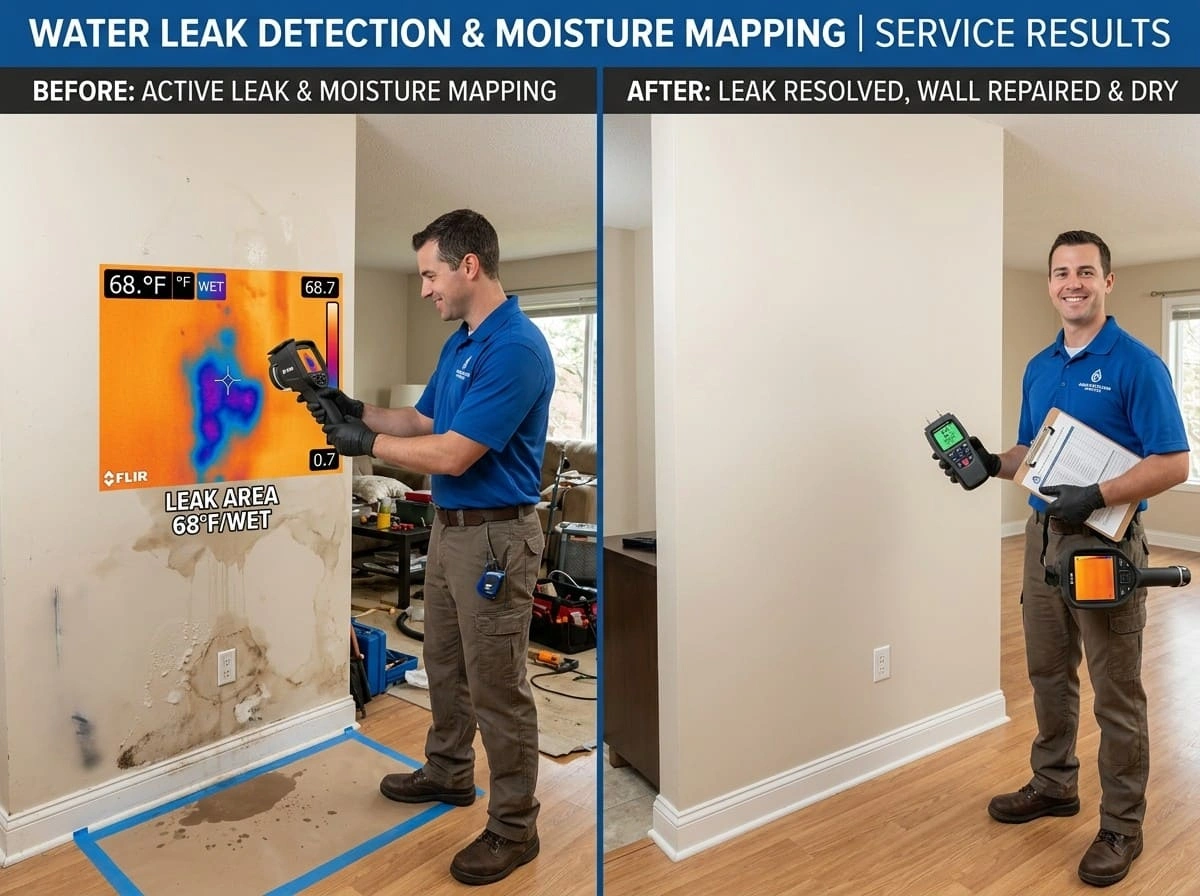
What Changes After Hidden Moisture Is Assessed and Documented
Many property owners call after discovering a stain, receiving a high water bill, finding a wet area, or noticing an odor without knowing where the water came from. The first goal is not to make assumptions. It is to establish what is affected, determine whether active water is present, and create a clear response plan.
A water stain, wet floor, or odor with no clear explanation.
Documented moisture conditions and a clearer understanding of the affected area.
Worry that every wall or floor may need to be opened.
A more targeted mitigation and access plan based on inspection and moisture readings.
Wet materials continue to sit after a plumbing, appliance, roof, or overflow incident.
Extraction, drying, monitoring, and repair planning are organized around the actual damage.
Uncertainty about what to provide to an insurer or property manager.
Photos, condition notes, moisture documentation, and restoration records are available.
How We Map Moisture Behind Walls, Floors and Ceilings
Practical Diagnostic Methods for Hidden Water Damage
Creek Auro Restoration uses appropriate assessment methods based on the type of water event, the visible conditions, the materials involved, and access to the suspected area. The goal is to gather reliable information before recommending broad demolition or unnecessary removal.
Assessment Methods May Include
- Visual inspection of accessible plumbing-adjacent areas, ceilings, walls, flooring, cabinets, appliances, and utility spaces
- Moisture meter water leak inspection for drywall, wood, trim, subflooring, cabinets, and other building materials
- Comparative readings between suspected wet areas and dry reference areas
- Moisture mapping to document the location and likely direction of water migration
- Thermal camera water leak inspection when appropriate and available to identify temperature patterns requiring closer review
- Humidity and environmental-condition readings to support structural-drying decisions
- Photo documentation, condition notes, and affected-area diagrams
- Coordination with qualified plumbing, roofing, irrigation, appliance, or HVAC professionals when specialized source diagnosis or repair is required
A thermal scan can help identify temperature differences associated with potential moisture or evaporation patterns, but it should be confirmed through other inspection methods. Moisture readings show the condition of materials, while source diagnosis may require plumbing tests, acoustic listening, pressure testing, tracer gas, or targeted access depending on the situation.
Should Water-Damaged Materials Be Dried or Replaced?
Helping Aurora Property Owners Choose the Right Restoration Path
Not every wet material must be removed. In some cases, prompt extraction, controlled drying, and monitoring can restore materials successfully. In other cases, saturated, contaminated, damaged, or inaccessible materials may need removal and replacement to protect the property and allow complete drying.
The right decision depends on the water source, duration of exposure, material type, moisture level, contamination risk, structural condition, and drying response.
| Material Condition | Drying May Be Appropriate | Removal or Replacement May Be Appropriate |
|---|---|---|
| Limited clean-water exposure caught quickly | Often possible when materials remain stable and respond to drying | May be needed if water remains trapped or damage expands |
| Wet drywall | Possible in limited situations with rapid drying and stable material | Often needed if drywall is saturated, softened, delaminated, contaminated, or mold-affected |
| Carpet and padding | Carpet may be restorable under certain clean-water conditions | Padding often needs removal; contaminated water may require disposal |
| Hardwood or laminate flooring | Controlled drying and monitoring may reduce damage | Replacement may be required for warping, cupping, separation, swelling, or structural damage |
| Ceiling materials | Drying may be considered if stable and lightly affected | Removal is often needed for sagging, softening, contamination, or collapse risk |
| Insulation | Limited drying may be possible in certain accessible situations | Removal is often appropriate because moisture can remain trapped |
When Removal or Replacement Is Often Necessary
- Materials are structurally weakened, swollen, crumbling, sagging, or deteriorated
- Water is contaminated or the source involves sewage or unsanitary conditions
- Moisture remains trapped and does not respond to controlled drying
- Materials are inaccessible and prevent adequate drying or inspection
- The property requires reconstruction after emergency mitigation is complete
What Does Water Leak Detection Cost in Aurora, CO?
Transparent Cost Drivers for Assessment, Drying and Water-Damage Restoration
The cost of water leak detection and moisture mapping depends on the size of the affected area, whether water is active, the accessibility of materials, the likely source, and the level of mitigation needed. A small accessible leak may require a focused inspection and drying plan, while a concealed leak under flooring, behind cabinets, inside a ceiling, or across multiple rooms can require more extensive moisture assessment and restoration work.
Creek Auro Restoration explains the scope, urgency, and cost drivers before work proceeds whenever conditions allow.
Primary Cost Drivers
- Emergency response versus scheduled assessment
- Active water, standing water, or a historic stain with no active flow
- Number of rooms, materials, and building components affected
- Accessibility behind walls, ceilings, cabinets, flooring, crawl spaces, or utility areas
- Need for water extraction, containment, drying equipment, monitoring, sanitization, or demolition
- Type of water source and contamination risk
- Need for source-repair coordination with a plumber, roofer, appliance technician, irrigation professional, or other specialist
- Drywall, flooring, trim, ceiling, cabinet, insulation, and reconstruction needs
- Commercial-property access requirements, tenant coordination, and after-hours work
| Service Type | Typical Pricing Consideration |
|---|---|
| Initial moisture assessment | Scope depends on symptoms, access, materials, and urgency |
| Emergency water extraction | Depends on standing-water volume, affected rooms, and response needs |
| Structural drying | Depends on moisture spread, equipment needs, monitoring duration, and materials |
| Targeted demolition or material removal | Depends on location, material type, contamination, and disposal needs |
| Reconstruction | Depends on drywall, flooring, trim, cabinetry, ceiling, paint, and finish requirements |
| Commercial water-damage work | Depends on building size, unit count, access, occupancy, and operational needs |
When Should Aurora Property Owners Schedule a Moisture Inspection?
Signs That a Leak or Hidden Water Problem May Need Professional Attention
You do not need to wait for a major flood to schedule a water-damage assessment. A small, hidden leak can continue to wet building materials over time. Early inspection can help identify whether the issue is active, determine the affected area, and reduce the chance that a manageable problem becomes a larger restoration project.
Schedule Professional Assessment When You Notice
- A high water bill but no visible leak
- A water meter running when everything is off
- An Aurora Water continuous-flow alert or water-use notification
- A brown ceiling stain, peeling paint, bubbling wall finish, or damp drywall
- Wet carpet near a wall, swollen baseboards, soft floors, or buckling flooring
- A musty smell after a plumbing, appliance, roof, or overflow event
- Water under a kitchen sink, vanity, refrigerator, dishwasher, washing machine, or water heater
- Ceiling damage below an upstairs bathroom, laundry room, or kitchen
- A damp or warm spot on flooring that may suggest water below the surface
- A wet lawn patch, water pooling near the foundation, or suspected irrigation leak
- A burst or frozen pipe after a Colorado cold snap
- Basement water after a sump-pump failure, storm event, or drainage issue
Water Leak Detection for Commercial and Multi-Unit Properties in Aurora
Protecting Tenants, Operations and Building Materials Across Your Property Portfolio
Commercial and multi-unit water damage can affect more than one suite, unit, floor, or tenant. A leak above a ceiling, behind a shared wall, under a restroom, near a mechanical room, or within a common area can disrupt operations and create documentation challenges for facility managers, owners, HOAs, and insurers.
Creek Auro Restoration provides commercial water leak detection, moisture mapping, water extraction, drying, documentation, and reconstruction support throughout Aurora, Arapahoe County, and the Denver metro area.
| Commercial Service | Description |
|---|---|
| Commercial moisture assessment | Inspection and documentation of suspected water intrusion in accessible areas |
| Water extraction and mitigation | Emergency removal of standing water and stabilization of affected spaces |
| Structural drying | Drying plans for walls, floors, ceilings, contents, and building materials |
| Multi-unit coordination | Communication support for property managers, HOAs, tenants, and owners |
| Documentation support | Photos, moisture notes, drying records, scopes, and insurance-related documentation |
| Reconstruction planning | Repair planning after materials are dry and the water source is addressed |
Commercial Properties We Support
Why Commercial Property Owners Call Creek Auro Restoration
- 24/7 emergency availability when water threatens operations
- Documentation that supports property management and insurance communication
- Water extraction, drying, repair, and reconstruction coordination from one restoration provider
- Capacity to support occupied buildings, multi-unit properties, and time-sensitive water events
Benefits of Hiring Water Leak Detection Professionals in Aurora
Better Information, Faster Drying Decisions and Reduced Water-Damage Risk
A professional moisture assessment helps property owners make decisions based on actual conditions instead of guesses. When water is hidden behind finishes or beneath flooring, the visible stain may not show the full scope of moisture migration.
Identify elevated moisture before damage spreads further through building materials
Support earlier water extraction and structural drying when needed
Reduce guesswork before opening walls, ceilings, cabinets, or flooring
Document the affected area for property owners, managers, repair teams, and insurers
Help distinguish a potential plumbing, appliance, roof, shower, irrigation, or exterior-water issue
Create a clearer path from emergency response to drying, repair, and reconstruction
Protect business continuity by addressing water intrusion quickly in commercial settings
Provide practical next-step guidance when another specialist must correct the source
Why DIY Hidden Leak Investigation Can Be Risky
Protect Your Property and Avoid Unsafe Water-Damage Conditions
Trying to find a hidden leak by opening walls, pulling up flooring, removing ceiling materials, or using electrical tools around water can create additional damage and safety hazards. Household moisture meters may be useful for basic screening, but they do not replace professional interpretation, water-category assessment, structural-drying planning, or source-repair expertise.
Safety Warnings
- Do not touch electrical outlets, cords, appliances, panels, or equipment near standing water
- Do not enter an area beneath a sagging, cracked, or water-heavy ceiling
- Do not cut into walls or ceilings if plumbing, electrical wiring, or structural components may be present
- Do not use household fans to dry sewage-contaminated water or other potentially unsafe water
- Do not assume a visible stain shows the full extent of hidden moisture
- Do not delay emergency action if water is actively flowing, flooring is soft, or water is near electrical equipment
- Do not rely on thermal images alone to identify the exact source of a leak
Answers to Common Water Leak Questions in Aurora, CO
Quick answers for homeowners, managers and business owners.
How do I know if I have a hidden water leak in my Aurora home?
Common signs include a sudden high water bill, a moving water meter when fixtures are off, damp drywall, water stains, soft flooring, wet carpet near a wall, musty odors, swollen baseboards, low water pressure, or the sound of water running when no fixture is being used.
Why is my Aurora water bill high but I cannot find a leak?
Continuous water use can come from a running toilet, toilet flapper, leaking fixture, hidden supply-line issue, irrigation leak, exterior spigot, valve problem, appliance connection, or other ongoing water use. Aurora Water's EyeOnWater service allows customers to monitor usage and set continuous-flow alerts.
What does an Aurora Water continuous-flow alert mean?
Aurora Water explains that alerts can be triggered when a meter records uninterrupted water use for at least 24 hours. The cause may be a leak, a faucet or valve left on, a running toilet, irrigation use, or another source of continuous flow. Customers remain responsible for locating and correcting the cause.
What is moisture mapping for a water leak?
Moisture mapping is the process of taking and documenting moisture readings in building materials to show where water has traveled. It helps guide drying decisions, material-removal decisions, targeted access, and water-damage restoration planning.
Can a moisture meter find the exact plumbing leak?
Not by itself. A moisture meter can show that drywall, wood, flooring, trim, cabinets, or other materials are wetter than expected. The exact source may require visual inspection, plumbing diagnosis, pressure testing, acoustic leak detection, tracer gas, thermal imaging, appliance evaluation, roof inspection, or targeted access.
Can a thermal camera see a water leak behind a wall?
A thermal camera identifies surface-temperature differences that may point to an area needing closer inspection. It does not see through walls or always identify the precise leak source. Readings should be confirmed with moisture measurements and other appropriate investigation methods.
How can I find a water leak without tearing open walls?
Start with an inspection of visible conditions, water-meter activity, accessible fixtures, appliances, ceilings, walls, floors, and moisture readings. Professional assessment can help narrow the suspected area before targeted access is considered. However, some opening may still be needed to confirm and repair the source.
Can a plumber find a leak under the floor or concrete slab?
A licensed plumber may use pressure testing, acoustic tools, tracer gas, camera inspection, or other diagnostic methods depending on the plumbing system and suspected leak. Creek Auro Restoration can assess and document water impact in flooring, walls, and nearby materials, then coordinate next restoration steps after the source is addressed.
Is a slab leak an emergency?
It can be. Sudden water pressure loss, active water, damp or warm flooring, rapidly spreading moisture, a rising bill, buckling materials, electrical exposure, or water near structural components may require prompt attention. Even a small suspected slab or under-floor leak should be assessed before hidden moisture spreads.
Why is there a water stain on my ceiling but no active drip?
Who is responsible for a water leak on my Aurora property?
For leaks within a home or building, the property owner is generally responsible for the plumbing and fixtures on the property. Aurora Water provides alerts and utility information, but customers are responsible for locating and resolving leaks or excessive water-use causes.
Who is responsible for a sewer lateral leak in Aurora?
Aurora Water maintains public wastewater infrastructure, while the owner is responsible for plumbing inside the building and the private sewer service line/lateral that connects the property to the public system. If a backup occurs, contact the appropriate professionals, Aurora Water, and your insurer as needed.
Will water leak detection help with an insurance claim?
Documentation of the incident, moisture readings, photos, drying records, mitigation work, and repair recommendations can help you communicate with an insurer. Coverage depends on policy terms, exclusions, the cause of loss, deductibles, endorsements, and the insurer's decision.
What should I do if water is actively leaking?
If it is safe, shut off the fixture supply or the home's main water shutoff. Keep people away from electrical hazards and sagging ceilings, move valuables from the affected area if safe, take photos, and call for emergency help. Aurora Water encourages residents to know where their master shutoff is located.
Clear Findings, Practical Next Steps and Responsive Support
From the First Inspection Through Drying and Reconstruction Planning
Creek Auro Restoration is committed to clear communication, careful documentation, and restoration recommendations based on the condition of your property. We explain what we observe, identify the next practical steps, and help you understand whether the situation calls for extraction, drying, specialized source repair, material removal, or reconstruction.
We do not make unrealistic promises that every leak can be found without access or that every material can be saved. Instead, we provide a disciplined assessment process designed to narrow the affected area, reduce guesswork, and move your property toward a safe and effective recovery plan.
13901 E Quincy Ave
Aurora, CO 80015
United States
Credentials That Support Professional Moisture Assessment and Drying
Restoration Training That Matters When Water Affects Your Property
Water-damage restoration requires more than placing fans in a wet room. Proper assessment, documentation, material evaluation, moisture control, and structural drying all affect how a property recovers after a leak, overflow, appliance failure, roof intrusion, or flood event.
Creek Auro Restoration's stated certifications and specialized restoration credentials support water-damage assessment, structural drying, microbial-remediation planning, and water-loss response.
WRT
Water Damage Restoration Technician
ASD
Applied Structural Drying Technician
AMRT
Applied Microbial Remediation Technician
MWR
Master Water Restorer
WLS
Water Loss Specialist
Aurora requires state plumbing licensing documentation for plumbing contractors working in the city; restoration assessment and mitigation should not be presented as a substitute for licensed plumbing repair when the source requires plumbing work.
Emergency Water Leak Detection in Aurora, CO
Rapid Response When Water Threatens Your Home or Business
Water damage does not wait for business hours. A burst pipe, failed water heater, toilet overflow, dishwasher leak, ceiling drip, sump-pump failure, frozen pipe thaw, appliance connection failure, or sudden roof leak can quickly affect flooring, drywall, insulation, cabinets, and contents.
Creek Auro Restoration provides around-the-clock emergency water-damage response throughout Aurora and the Denver metro area. Our priority is to help stabilize the property, assess affected materials, begin appropriate mitigation, and document the damage.
Immediate Phone Consultation
Understand the water source, urgency, affected materials, and safety concerns.
Shutoff & Safety Guidance
Help shutting off water when safe and protecting the area from electrical hazards.
Rapid Team Dispatch
Dispatch of a restoration team for active water, emergency extraction, moisture assessment, and stabilization.
Source-Repair Coordination
Recommendations when a plumber, roofer, appliance technician, irrigation specialist, or other source-repair professional is needed.
Insurance Documentation
Records and photos that can support insurance communication and reconstruction planning.
Call Immediately For
- Burst pipes or frozen pipes that begin leaking after a thaw
- Ceiling leaks, sagging ceilings, or water near electrical areas
- Water heater, dishwasher, refrigerator, washing-machine, or appliance leaks
- Overflowing toilets, tubs, sinks, or drains
- Wet basements, sump-pump failures, and storm-related water intrusion
- Wet carpet, soaked drywall, damaged hardwood, or a large water stain spreading quickly
- A suspected hidden leak causing active water damage
Insurance Claim Assistance for Water Leak and Water Damage Incidents
Documentation That Helps You Navigate the Restoration Process
Water damage claims often require clear records of what happened, when it was discovered, what materials were affected, what mitigation was performed, and what repair work may be necessary. Creek Auro Restoration helps owners and managers document the restoration side of the event so they can communicate more effectively with their insurance carrier.
Insurance-Support Documentation May Include
- Initial condition photos of visible water, stains, damaged materials, and affected areas
- Moisture readings, moisture maps, and assessment notes
- Emergency extraction, drying-equipment, and monitoring documentation
- Itemized mitigation scopes, invoices, and recommended next steps
- Records describing the apparent water source and any source-repair coordination needs
- Communication support for homeowners, property managers, HOAs, and commercial facilities
- Direct insurance-billing coordination where accepted and appropriate
Policy note: Insurance coverage depends on the cause of loss, policy language, exclusions, deductibles, water-backup endorsements, flood coverage, mold-related provisions, and the insurer's claim decision. Creek Auro Restoration can provide restoration documentation and coordination support, but cannot guarantee claim approval or coverage.
Understanding Warranty Coverage After Water Damage Restoration
Clear Documentation for Drying, Repairs and Reconstruction Work
Warranty coverage depends on the specific work performed, the materials used, the cause of the original damage, manufacturer terms, and whether the underlying water source has been properly corrected. Creek Auro Restoration provides project-specific documentation so property owners understand the scope of completed work and any applicable workmanship or product coverage.
| Coverage Type | What It May Include |
|---|---|
| Drying and mitigation documentation | Records of moisture conditions, equipment use, monitoring, and completed mitigation scope |
| Repair workmanship | Project-specific workmanship coverage for qualifying repair or reconstruction work |
| Materials and replacement products | Manufacturer warranty information for qualifying new materials or components |
| Project records | Documentation useful for future maintenance, repairs, sale disclosures, or insurance communication |
Important Warranty Notes
- Warranty terms vary by project scope, material manufacturer, cause of loss, and completed repair type
- New materials may carry separate manufacturer coverage
- Water-damage repair warranties do not cover a new or continuing leak, roof issue, plumbing failure, appliance failure, or other source problem that has not been corrected
- Keep copies of project documentation, invoices, and source-repair records for your property files
10 Equipped Service Vans Serving Aurora and the Denver Metro Area
Water Extraction, Moisture Assessment and Drying Equipment Ready When Needed
Creek Auro Restoration maintains 10 equipped service vans to support emergency water-damage response across Aurora and nearby communities. Our teams bring restoration tools and materials needed to assess wet building materials, begin mitigation, document conditions, and support structural drying.
Moisture meters and assessment tools for evaluating affected materials
Water-extraction equipment for emergency removal of standing water
Air movers and dehumidification equipment for structural drying
Containment and protective materials for controlled mitigation work
Documentation tools for photos, condition records, moisture notes, and work planning
Restoration equipment for drywall, flooring, ceiling, cabinet, and related water-damage projects
Emergency-response supplies for homes, multi-family properties, commercial facilities, and managed locations
Payment Options for Major Water Damage Repair and Reconstruction
Helping You Plan for Restoration Work After the Emergency
A hidden leak can sometimes affect more than the first visible area. Once water has reached drywall, flooring, cabinetry, ceilings, insulation, trim, or multiple rooms, a property may require a larger restoration and reconstruction plan after emergency drying is complete.
Creek Auro Restoration can discuss project scope, insurance coordination, and payment considerations for qualifying restoration work. Clear communication helps property owners understand what work is urgent, what work should follow drying verification, and what reconstruction priorities may be needed.
Planning Considerations
- Emergency mitigation may need to begin before final reconstruction scope is known
- Insurance proceeds, deductibles, and covered work vary by policy and claim decision
- Larger projects may be phased between emergency mitigation, drying, repairs, and finish restoration
- Multi-unit, commercial, and property-management projects may require coordinated scheduling and written scope planning
- Ask our team about available payment and project-planning options for qualifying work
Service Standards Built Around Responsive Water Damage Care
A Local Team Focused on Clear Communication and Property Recovery
Creek Auro Restoration focuses on the work that matters during a water emergency: responding promptly, documenting conditions, protecting affected materials, coordinating drying, and helping owners move from uncertainty toward a practical restoration plan.
When reviewing any third-party recognition, award, rating, certification, or directory listing associated with a restoration provider, property owners should verify the current source, issuing organization, date, scope, and relevance of the claim before relying on it.
Restoration training relevant to water damage, structural drying, and microbial remediation
Documented emergency-response process and clear scope communication
Ability to provide moisture readings, condition photos, and drying records
Experience with residential, commercial, multi-unit, and managed properties
Clear insurance-documentation practices and realistic coverage disclosures
Transparent explanation of source-repair coordination and reconstruction options
Ask About Current Water Damage Service Offers
Support for Aurora Homeowners, Seniors, Veterans and Property Owners
Water damage can create an unexpected expense, especially when a leak affects flooring, drywall, ceilings, cabinets, or multiple areas of a property. Creek Auro Restoration encourages homeowners, senior citizens, active-duty military personnel, veterans, and property managers to ask about any current service offers, project-planning options, or available restoration-support programs before authorizing non-emergency work.
Emergency mitigation should not be delayed when active water, electrical risk, sagging ceilings, contaminated water, or rapidly spreading damage is present.
Ask Our Team About
- Current emergency-assessment and visual-inspection availability
- Restoration project planning after drying and source repair
- Insurance-documentation and direct-billing coordination where appropriate
- Available bundled work options for qualifying restoration and sanitization needs
- Current promotions or support options that may apply to qualifying services
Water Leak Detection Hours in Aurora, CO
24/7 Availability for Emergency Water Damage Response
A burst pipe, flooded basement, ceiling leak, appliance failure, toilet overflow, or water-heater leak can happen at any hour. Creek Auro Restoration operates 24 hours a day, seven days a week, for emergency water-damage response in Aurora and the surrounding Denver metro area.
| Day | Emergency Service Hours |
|---|---|
| Monday | 00:00 – 23:59 |
| Tuesday | 00:00 – 23:59 |
| Wednesday | 00:00 – 23:59 |
| Thursday | 00:00 – 23:59 |
| Friday | 00:00 – 23:59 |
| Saturday | 00:00 – 23:59 |
| Sunday | 00:00 – 23:59 |
Why Choose Creek Auro Restoration for Water Leak Detection in Aurora?
A Restoration-Focused Approach to Hidden Moisture, Drying and Recovery
Not every provider approaches a suspected leak from a full restoration perspective. A plumbing professional may diagnose and repair the source of a plumbing failure, while a restoration company assesses moisture impact, begins water mitigation, dries affected materials, documents conditions, and supports repairs after the source is corrected.
Creek Auro Restoration helps property owners coordinate the water-damage response around what the property needs next.
| Service Consideration | Creek Auro Restoration Approach | What Property Owners Should Confirm With Any Provider |
|---|---|---|
| Hidden moisture assessment | Moisture readings, documented affected areas, and restoration-focused evaluation | Whether the provider evaluates moisture beyond visible surfaces |
| Emergency response | 24/7 availability for water-damage emergencies | Actual after-hours availability and emergency scope |
| Water mitigation | Extraction, structural drying, and damage stabilization support | Whether mitigation can begin quickly after active water is controlled |
| Source repair coordination | Clear guidance when plumbing, roofing, appliance, irrigation, or other repair is needed | Whether the source-repair trade is properly qualified and licensed |
| Documentation | Photos, moisture notes, drying records, and restoration scope support | Whether records are detailed enough for owners and insurers |
| Repair and reconstruction | Water-damage repair and reconstruction planning after drying | Whether the provider can explain the transition from mitigation to repair |
Contact Creek Auro Restoration for Water Leak Detection in Aurora, CO
Talk with a water damage restoration professional today.
If you have a high water bill but no visible leak, a water stain on the ceiling, wet drywall, a musty odor, wet carpet near a wall, a suspected leak under concrete slab, or water damage after an appliance, roof, toilet, or pipe problem, Creek Auro Restoration is ready to help.
Our team can assess accessible affected areas, document moisture conditions, explain the likely water-migration path, begin emergency mitigation when needed, and help you understand the next step toward source repair, drying, restoration, and reconstruction.
Contact Creek Auro Restoration
(719) 715-6006
creekaurorestoration@gmail.com
waterdamagerestorationaurora.com
13901 E Quincy Ave
Aurora, CO 80015
United States
24/7 Emergency Service Available
For fast, professional Water Leak Detection Aurora CO property owners can depend on, contact Creek Auro Restoration 24/7 for moisture mapping, emergency water mitigation, structural drying, and water-damage restoration support.